

Thinking about counselling with Dean Richardson, but need a swift answer to a question? Below you will find the most common questions put to Dean about his private counselling services
Plus, if you have a question about counselling (with or without Dean) that isn’t included on this page? Use the comments section below to ask.
On This Page...
Fast Answers to Common Counselling Questions.
Where are you?
I’m in two places:
Portsmouth: 5 miles north of Portsmouth in Widley (96a London Road, Widley, PO5 3AB) (click to read more…).
Skype: on video via your computer/Skype device (click to read more…)
What can I expect when I come to see you?
You’ll take a seat in the waiting room, help yourself to a mint or sweet, and read a magazine.
I will come to take you to our room on the hour of our session.
I’ll introduce myself, invite you to have a seat opposite me & maybe pour yourself a glass of water, and I’ll outline what we’re going to do during the first session. The whole session will usually be conversation based: no forms to fill in, no tests to take, no using toys or equipment (like in art therapy). I do have pens, paper and a whiteboard to draw on if you want to use that.
- We’ll talk about confidentiality, and what that means in different contexts such as the law.
- We’ll do a bit of admin (name, address, age etc).
- We’ll then give you the space and time to begin telling your story in just the way you want to.
There’s no problem too large or too small to speak about. As you talk, I may check that I’ve understood you. I may ask you a question or two as we go alone. Sometimes I may tell you what I thought I heard from you, and I’ll offer a thought or two to see how well you accept this (or not). It’s my job to help you feel understood, to feel listened to, and to make sure that you feel as relaxed as you can manage, to talk about yourself freely. Of course, some people still feel anxious, but that’s very normal.
Sometimes, something I say might trigger a thought that you’d not been prepared to speak about – and you’re welcome to talk about those thoughts too (but only if you want to). Plus you’re welcome to talk about your reservations about me or my approach to counselling – and you’re welcome to query anything I say that doesn’t make sense (or if you felt uncomfortable with something I just said) – I will not be offended.
At the end it will not be unusual for you to feel quite tired, but also to feel a sense of less burden.
This would be the beginning of building a good relationship together (a therapeutic alliance) in which we might begin to tackle some more difficult matters together.
Do I have to pay for counselling?
I deliver counselling by my private counselling practice, so I charge a fee for each 50-minute session. You don’t have to be referred by a doctor, you are not limited to a set number of sessions (no minimum and no maximum), sessions are weekly (same time/day) and we can work through difficulties until you’re comfortable that we’ve done enough to stop.
Some organisations (like charities) offer counselling for a low fee, or for a strictly limited number of sessions.
An NHS GP surgery sometimes have counsellors on staff – and you may be able to obtain up to six sessions without paying. This will depend on being referred by your GP, on waiting times and on availability.
How much do you charge?
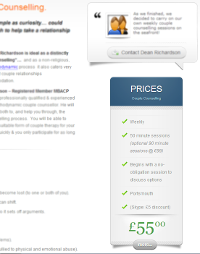
I have different fees for different forms of counselling. To make it easy to know the prices: on each counselling page, on the right hand side, you will find the price of that service.
But, for a quick table of all my prices: see my Fees Page.
I ask for a £30 deposit to be paid before the first session (only).
If your income would prevent you from affording private counselling, read about my approach to a sliding scale and then talk with me.
What payment methods do you accept?
In person: cash, cheque, postal orders, credit card*, debt cards*
Online: bank transfer, PayPal**, credit card**, debt cards**
*paying in person by card costs an additional £1.50 / **paying online by a card or PayPal costs an additional 4%
See my How to Pay page for details.
Do you offer payment plans?
Session fees become due on the day of the session.
If you have been paying weekly, and your financial circumstances change, please discuss this with me. We can talk about creative ways for you to manage the fees for continuing counselling – which might include reviewing what you pay (read about my sliding scale). Alternatively, we might think about ending counselling for now (if you choose).
If you are persistently late with payments, or you are running up an unpaid bill with me, we will need to talk this through to decide together how we tackle this.
Do you accept Insurance / NHS Referrals?
I have decided not deal with insurance companies (such as Employee Assistance Programs) due to poor experiences with their general attitude towards a person’s privacy, safety or to their therapeutic needs.
The NHS provides no mechanism to obtain your counselling fees from them. I cannot accept NHS/GP Referrals unless you are willing to work with me on private basis (e.g. paying for your own counselling).
If you have an insurance – or other – arrangement whereby you can claim your counselling costs directly, then I will work with you.
If you find your income makes my fees difficult to afford, have a look at my offer on affording private counselling.
How soon can I book?
You can book now (contact me) – and it takes about a week to arrange our first meeting.
So if today was Monday 1st February, and you contacted me today, we’d be looking at meeting on any date from (and including) Monday 8th February onwards.
Can I see you now!?
The forms of counselling I offer do not cover “emergency” counselling; you need to be able to look after yourself in between sessions (and before seeing me for the first time).
If you’re in crisis, maybe one of these resources might help:-
| The Samaritans. Immediately available:08457 90 90 90. | Lifeline Project Help with drugs addiction & abuse. | Shelter. The Housing & Homeless Charity. |
| Police (Non Emergency) Telephone: 101 (costs 15p per call) | NHS Direct Telephone: 111 (free of charge) | Lesbian & Gay Switchboard. Telephone 0300 330 0630 |
When are you open?
| Day of Week | Times of Day |
|---|
I’m open on weekdays but not open on weekends.
Once you’ve begun working with me in counselling, that day and time is yours every week until we’re done.
So the table of appointments (right) show where I have places available now (the times-of-day when I’m available to meet with you for counselling).
How do I start counselling?
You can do it in as few as five easy steps – and I’ve written a page on How to Begin Counselling.
Will counselling be right for me?
Good question – can’t answer that here – but if you come and meet with me for a one-off, no-obligation, session then we can see if it does you any good.
If we don’t mesh, can you refer me / help me find / suggest another counsellor?
Yes I can.
How many sessions will I have to have?
That’s actually up to you.
Counselling effects different people in different ways, and because you are part of the process (counselling isn’t something that I do to you) you and your needs will be part of the calculation.
Because of my ethical boundaries (see British Association for Counselling & Psychotherapy Ethical Framework for Good Practice in Counselling / Psychotherapy: http://www.bacp.co.uk/ethical_framework/ ) I cannot keep you in counselling, nor force you to attend beyond the point you want to stop.
So, in general, we can either set a specific number of session (eg 12) or meet for as long as it does you some good. And when it appears to have done enough we will talk about how we begin to say goodbye.
What’s the longest/shortest someone has been in counselling with you?
Shortest: 1 session (one session was asked for, one session was given).
Longest: 5 years (approx 200 sessions).
How long do sessions last?
Generally, all sessions last for 50 minutes and begin on the hour.
By prior arrangement, sessions of 90 minutes are available (still beginning on the hour).
As an effective counsellor, good timekeeping is important and (unlike many GP surgeries and, unfortunately, unlike one or two other counsellors I’ve come across in my time) you will not be waiting in reception way past your session time, not knowing when I’m going to come out of the room.
What can I do if I struggle between sessions?
Firstly, we can talk, in session, about any struggles you’re having in-between sessions.
Secondly, it’s important you are (or may be) someone who can take responsibility for your feelings and your behaviour and that you are someone who can self-sooth, or at least seek support from family, friends, or anyone you can trust. I will be available only to you during sessions, and will not be available on-demand (eg Facebook, email, or SMS texts).
Can I see you without my partner?
If you’re not sure if you want couple counselling or individual counselling, come and talk with me.
Once we’ve committed to one form of counselling: I choose not to work with you in another form of counselling. So, if you begin with me in individual counselling and later wanted to begin couple counselling, because your partner doesn’t know what I know about what you’ve said about them it would be best to consider another counsellor for couple counselling.
If you’re in couple counselling with me, and your partner cannot attend a session, we will have spoken about what we can do in those circumstances (for instance, because).
If you’re in couple counselling with me, and your partner stops coming, we can work together for up to six sessions to bring our work to a close… and you may transfer to another counsellor to continue any outstanding individual work.
Can I tell you something I don’t want my partner to know?
If we’re engaging in couple counselling, during your initial interview (see Assessments for Couples) there may be something you want to discuss with the counsellor that your partner does not know about.
You will be asking your counsellor to share in something that’s a secret from your partner – and this can take some careful discussion; but don’t be put off as the counsellor is experienced in matters like these.
Ultimately – the counsellor will not divulge something you don’t want your partner to know about … but we will talk about how eventually you will need to divulge the matter yourself.
Am I crazy / going insane?
For many people, counselling with Dean Richardson has helped them understand stuff going on in their lives when, previously, what was happening made no sense.
Chances are: you’re not crazy nor going insane.
But… if you are seriously concerned for your mental health you aught to speak with a medical professional (a GP, a doctor at the hospital etc) to at least have them put your mind to rest or offer you appropriate treatment.
Dean is a qualified & accredited counsellor with over 15 years of experience – but he is not of the medical profession and is not qualified to make medical diagnoses.
Can I talk to you about something I’ve done illegally?
You can – but you need to be aware of some things.
The relationship with a counselling is private and confidential, but it does not override the law.
If you tell me something about, say your intention to harm someone, to a child, or to a group of people (e.g. terrorism) then the law requires that I do not keep that to myself. It’s not that I’m going to run out of the room to dial 999… but you must understand that I may not be able to keep your privacy where the law overrides us; there is no privilege in counselling.
Similarly, if you have already been arrested for something and you need support during criminal investigations, you can come to me for counselling. I may be requested to appear in court. This can be one of two positions:
- as an expert witness (where I would be asked to give my opinions) however this would be unusual where I was your counselling,
- as a lay witness where I would be asked about what we had spoken about (without necessarily being asked to give my professional opinion).
If you are in doubt as to your legal/court situation as to whether to come to me for counselling, you are best consulting a solicitor or the citizen’s advice bureaux for legal advice.
Got a question not covered in the above list?
Write it in the comments section below and I’ll help.
Or proceed to the next page: FAQ Articles…