Categories
FAQ

LGBTQI Language Phrases, Abbreviations & Acronyms

This is a list of (mostly) LGBT-orientated language abbreviations & acronyms. They are intended for therapists thinking about expanding into working with LGBTQI clients and who might like a crash course in lifestyle-language.  They will also be useful for anyone interested.

This list is small but I hope to expand it.

PLEASE HELP: if you’d like to help by added something please use the comments section below to suggest or correct an entry.

Index:  A  B  C  D  E  F  G  H  I  J  K  L  M  N  O  P  Q  R  S  T  U  V  W  XYZ

A

B

BDSM: “Bondage/discipline, dominance/submission, sadism/masochism”
A type of role-play – and sometimes a lifetstyle – between two or more who use the practice to experience a mix of pain and power as an erotic or sexual experience.
http://en.wikipedia.org/wiki/BDSM

BEARD:
Sometimes ‘lesbian beard’ – a woman who becomes the girlfriend/wife of a gay man in order to deflect suspicions of homosexuality primarily away from the man (although may also be a mutually satisfactory arrangement for a lesbian and gay-man).
http://lesbianlife.about.com/od/herstory/g/Beard.htm

BUTCH:
A lesbian woman who appears to be demonstrate more masculine-than-feminine behaviour (eg aggression, dominance).
http://lesbianlife.about.com/cs/transdykes/g/butch.htm

C

CBT: “Cock & Ball Torture”
Sexual play involving the delivery of pain to the penis and testicles – the sexual pleasure is mostly gained from the masochistic receipt, but somewhat too from the sadistic delivery. Torture may involve waxing, kicking, squeezing, hitting, flogging, urethral play etc.
http://en.wikipedia.org/wiki/Cock_and_ball_torture_(8sexual_practice)

Closet: “In the closet”
Term (usually applying to males but equally appropriate to females) to imply a person’s sexual orientation or gender identification is different from the majority and is not publicly known. Goes hand in hand with out.
http://en.wikipedia.org/wiki/Closeted

D

E

F

FEMME / FEM:
A lesbian woman who appears to demonstrate proportionally more femanine-than-mascline behaviour and/or appearance.
http://lesbianlife.about.com/cs/comingout/g/Femme.htm

G

H

I

J

K

L

Lesbian Bed Death:
Term coin by Pepper Schwartz in her 1983 book American Couples – the study suggesting that lesbians in committed relationships suffer the most decline in sexual intimacy the longer the relationship lasts.  The study has been critisised and the conclusions given as myth, however the phrase is used by some to express concern about their relationship’s decline.
http://en.wikipedia.org/wiki/Lesbian_bed_death

LGBTQI: “Lesbian, Gay, Bisexual, Trans(gender/vestite), Questioning(Queer), Intersexed(Inquisitive)”
Self-classification from the LGBT community. Different variations include: GLBT (primarily American), LGBT, LGB etc…

M

N

O

Out: “Out of the closet
Term used to describe someone who has announced their sexuality as being different from the majority (eg gay / lesbian).  Can also refer to gender identification.  Being used more commonly nowadays as an esoteric term to refer to someone who makes something public known about themselves that was previously secret.

P

PEP: Post Exposure Prophylaxis
A treatment to attempt to stop infection by the HIV virus shortly after exposure.
http://www.pep.chapsonline.org.uk/pep_basics.htm

Q

R

S

SORTED:
Personal description implying the person has no psychological or emotional problems.

SOUNDING:
The use of medical-orientated equipment to stretch the urethra (primarily in males / the penis) as a form of sexual play.
http://www.chaseunion.com/documents/urethra/sounds.htm

T

U

V

W

XYZ


Please help me expand this list by adding further suggestions and amendments using the comments section below…

Categories
Therapies

The A, B & C of Working with a new Counsellor.

When you have the opportunity to begin therapy with a counsellor, the initial meeting will bring up anxieties for many therapy-newbies.  Even experienced patients can get the heeby-jeebies before the assessment, and whilst this is probably the same social anxieties as you might experience when meeting with anyone new, the counselling assessment may be just that little more distressing.

It’s untrue that counsellors, psychotherapist and psychiatrist can read into your very soul!  At the same time, it’s particularly true that many experienced counsellors do gain the experience of being able to understand where a new client is coming from during the client’s story.  Counsellors call it empathy, and the more ethical ones of us counsellors use it to try and help you understand yourself. But, this isn’t going to be an article on how kind and amazingly helpful we, as therapists, are! 

Because of recent reports of counsellor/client imbalance (who knows – maybe it’s always been so) I’d like to give you three tips that may help you face your new therapist for the first time.  I’d like you to feel a little more empowered than you may normally do.  Introducing my A, B, C of working with a new Counsellor.


A is for Authenticity

[dropcap style=”font-size:52pt;color:black”]A[/dropcap] is for Authenticity.

During the first meeting with a counsellor, you’ll probably be asked a series of questions.  This isn’t always true, though.  Some therapists pride themselves in being able to work therapeutically without asking any questions at all. Amazing (even frustrating) as thatm ight be, we’ll save that discussion for another time.

So – “A” is for authenticity – meaning: be true as yourself to yourself as you can be in any of your replies to the counsellor.  The counsellor isn’t trying to trap you or catch you out.  The therapist is trying to learn about you and your story, primarily so that the therapist can judge if they are the right person to be working with you.  If you don’t know an answer, say so.  If you’d rather not answer a question, you can say you’d prefer not to answer that.  The counsellor may be curious (and hopefully respectful of your reply too) and may ask you to say a little more.  Again, if you’d prefer not to go into a subject area you can decline to do so.

An assessment should be a mutual one – you’re assessing the therapist too. Being authentic means that you will get a better experience from a counsellor who is, too, trying to be as authentic with you as possible.


B is for Behaviour

[dropcap style=”font-size:52pt;color:black”]B[/dropcap] is for Behaviour.

Don’t change your usual behaviour.  Or, if for reasons of social niceties you feel you do have to change your behaviour, share with the counsellor your change in behaviour and try to describe how you might normally behave.

Socially, we humans can have a whole series of different behaviours that we bring out depending on what situation we’re in.  Sometimes we’re the life of the party.  Sometimes we’re the businessman that invites new business orders.  Sometimes we’re the dad picking up his kid from school surrounded by female-conversation we feel awkward to join in with. But meeting with a counsellor is about you, the inner person, and behaving just as your true, authentic self is best.

If your behaviour is effecting your life, and it’s something you want to change as part of the therapy, then it’s useful to discuss this with your counsellor too – your counsellor may need to learn about those behaviours … and you’re the tutor


C is for Challenging the Counsellor

[dropcap style=”font-size:52pt;color:black”]C[/dropcap] is for Challenging the Counsellor.

You’re meeting with a counsellor, presumably, to find to help.  If the counsellor is asking questions that make you uncomfortable, or the counsellor says something that disturbs you, challenge the counsellor.  You don’t have to feel that you must comply with the counsellor because you’re feeling forced to do so.  If you’re not receiving help, you have the right to point this out.

Challenging doesn’t have to be confrontational or impolite.  It can be a simple way to show that you don’t agree with the counsellor, or that you would like the counsellor to be somewhat more clear about what he or she has just said.  if we remember that counselling is a partnership there are a vast number of studies that it is the relationship between counsellor and client that makes the difference – not what the counsellor does to you. 

So, if you feel uncomfortable about what’s been said to you, challenge the counsellor to explain more.

Addressing Client/Counsellor Imbalance.

This article has had a hidden agenda – it’s been about addressing a reported-increase in the imbalanced between the some counsellor/client relationships.

At the present time, Increased Access to Psychological Therapies (IAPT) at the NHS has introduced an increase of newly trained CBT counsellors.  Whilst this is a good thing, unfortunately the practice of IAPT low-level CBT intervention offered by newly-qualified IAPT therapists has, somehow, embraced the medical approach to therapy.  Doctors practice the role:  “there’s something wrong with you, and I have to cure you.”  This is leading to an unfortunate counselling-practice of “I am the counsellor, so I have to cure you.”

Studies show that counselling and psychological therapies are effective because of the relationship between the therapist and client.  The effectiveness is not because of being given instructions-to-follow in order to be cured by the counsellor.

This is not an attack on CBT.  This therapist incorporates CBT in his private practice.  I incorporate CBT from a position of collaboration and empathy between myself and my client – we’re in this shit together.  In my professional opinion, the client experiencing a newly qualified therapist’s sometimes-dominant instruction is counter-productive.  You cannot be cured of anything by being told what to do (except, perhaps, allowing for a sadistic/masochistic relationship being played out between the counsellor and client – a discussion for another articl).

This article offers you, the client, the very legitimate and very real approach that you’re a fellow in the therapy. You are not a subordinate, and I hope you won’t feel like you are when you next go to meet with a new counsellor.

A, B, C and meet your counsellor with the expectation of equality & collaboration.

Enjoy your first meeting with your new counsellor!

Categories
News Uncategorized

“In Treatment” returns for Season 3 – Sky Atlantic

Saturday 12th November 2011 – Sky Atlantic – “In Treatment” returns for its third and final season (see http://skyatlantic.sky.com/in-treatment/gabriel-byrne-returns-for-the-final-season-of-in-treatment).

“In Treatment” is based on BeTipul – a drama portraying real-life psychotherapeutic sessions between psychologist and his patients.  Each episode is focussed upon one session between client and therapist and over time one sessions how the therapeutic alliance progresses as the therapy develops.  We are fortunate in that we get to understand what’s going on in the therapist’s mind by being able to attend his own supervision (and sometimes his own therapy) so that we sometimes can learn how the therapist uses his experiences and struggles of clients (eg his ‘counter-transference’) in order to help the clients themselves.

Gripping drama – accurately portrayed.

Because I do not video nor record any of my therapy work for reasons of confidentiality, “In Treatment” is an excellent demonstration to show people, who are interested in my work as a psychodynamic counsellor, how our clinical work could progress between us as client-and-therapist.

“In Treatment” episodes are on Saturdays at 10pm and 10:30pm, followed by Sunday at the same time.

Categories
Couple Relationships

Five Secrets of Happier Couples

As a professional couple’s counsellor, it’s an occupational hazard that I only get to work with unhappy couples.  Fortunately, I often do get to experience a transitional stage where a couple begin to transform their relationship into something that’s more positive and more happy for the two of them.

I am sharing these five “secrets” (not really secret!) based upon my observations.  Whether heterosexual, gay or lesbian, how couples moves their relationship from an unhappy state into a more happier state have common features.

1) Couples spend quality time on their relationship.

At least by the time a couple begins to meet with me for couple therapy, the couple have stopped spending time on the relationship.

This is sometimes due to the fact that sometimes couple learn to not communicate for very good reasons – and by not spending time on the relationship those reasons can be kept under lock and key

Living together is not spending time on the relationship.  The relationship is that thing that the couple have created together (and sometimes begin to destroy together).  Learning what the relationship is for a couple (it can be different for each couple) is the first step. 

  • Some couples set a “date” night once a week. 
  • Some set a meeting night once a week to discuss their relationship.
  • Some keep a “relationship” diary where both partners can write messages to the relationship about what’s going well (or not).

Sometimes a poorly relationship needs some focussed time spending on it.  It can simply be that the couple have forgotten that their relationship needs care, and for a while it needs to be nursed back into help.

2) Couples can hear each other’s communication.

One of the more frequent interventions I make in couple’s counselling is “What did you make of what your partner just said, there?”.

Couples who are in a distressing relationship can often answer “I don’t know”, or misunderstand their partner, or say things like “Well if he/she loved me I wouldn’t need to explain”.  These couples have have lost their skills in communicating.  It can be a very painful state to be in.

Inviting each partner to learn what the other partner is saying can be very helpful.  If a partner gets the communicate message wrong, it’s helpful for the partner to patiently teach the other what was meant (avoiding chastisement).

3) Couples can be comfortable when apart from the relationship.

Some couples have found they have unintentionally excommunicated all their friends to the point where only their partner exists in their world.  There may have been an unintended plan in doing this – I’m talking attachment styles.

When thinking about attachment styles (eg the early relationship of the infant to its caregiver) the infant may be secure; that when mum goes out of the room the infant will carry on playing, knowing at some level that mum will be back in a bit.  On the opposite scale, an insecurely attached infant will be greatly distressed when mum disappears for a little bit. For more on attachment styles, read “Attachment Theory – an Overview”.

Deeply felt insecurities may manifest in the relationship.  Jealously (“where were you all night?”), suspicion (“who are you seeing behind my back?”), are just two manifestations.

Having partners understand how each other attach in intimate relationships can help both partners appreciate where unpopular behaviour stems from (sometimes way back in the past).  Showing consistency (eg going out with the lads every Thursday night causes anxiety, but coming back home at an hour both partners agreed) can greatly help address initial change from insecure attachment to something more secure.  Secure attachment can handle unplanned behaviour (eg coming home late) where as insecure attachment may not.

4) Couples can share the truth / show authenticity.

No-one can tell when you’re lying.  Honest!

There are many reasons why people lie, and as a therapist one of the greatest demands on my practice is consistently authentic.  It’s essential that I demonstrate trust-able behaviour, consistent responses, holding boundaries agreed up front.  It’s a form of replaying the holding care that a care giver does (or should) when the infant is very small.

In the beginning, it’s likely that you and your partner were more truthful with each other than later in the relationship (ever heard of “pillow talk”, for example?)

Introducing inauthentic behaviour or telling lies will be felt at some level by our partner.  If you find there isn’t a place to tell the truth, maybe secret #1 might be the first place to address this.

5) Couples recognise their relationship as being unique.

When problems arise, everyone may have a say: your family, your friends, your partners family & friends, work colleagues, the people next door.  They’ve all been through it… but have they?

In couple therapy, part of my role is to provide an encouraging atmosphere of promoting the couple coming up with ideas and solutions of their own.  I don’t have any exercise that if performed correctly will cure the relationship’s problems.  I have no magic words that will make the unhappiness go away.  But what I do do is help a couple to realise that their relationship is pretty much unique and that they do not have to adhere to what society says is the behaviour of a happy relationship (see Secret #4!).

In society, we usually want to fit in, so we make our behaviour fit with everyone else.  We know that mum and dad never had a bad word and never argued.  We know that the couple over the road were married for 70 years and never spent an might apart.  Except … what people say about how their relationship works may not be quite the truthful story.

Helping a couple to disengage with what they think is supposed to be the right way to behave in a relationship, and helping them engage creatively and with inspiration with what they would both like in the way of relationship-behaviour can contribute greately to making their relationship work … after all, there’s no relationship quite like theirs.

Categories
B2B Ethics

Did your client read that Tweet?

Over on Facebook, the Business & Marketing Skills for Therapist Group (here) are helpfully discussing how they can get their message about their practices (etc) out into a wider world.  Some members of the group are professional marketeers, some members are professional therapists.  Something happened to me today that made me notice something that’s essential to therapists as we learn to market our services using public social networks. 

Let me share with you a story…

Tweeting? Twittering? Tweeping?

Over the past month or so I’ve been posting information about counselling on Twitter. I have only 90-or-so followers (compare this with Stephen Fry who has nearly 4 million followers). It’s good fun, it strengthens my reflective practice, it gets me known a little more and brings some new folk to my website.

One might think that 90 people – some of whom are porn stars, one of whom I’m sure is not really a hedgehog, and some of whom seem to hope I’ll be buying their obscure products any moment now – are all who are reading my posts. Maybe not even 10% of the 90 are really reading what I haven’t say.  So little feedback, you see.  So, what might it matter if I might casually slip in a small case example to demonstrate a point in a Tweet?  What harm could 140 characters cause?  It’s only 9-ish people that’ll ever read what I tweeted.

The issue, though, isn’t how few people are reading me (or you, dear fellow therapist, once you hit that Tipping Point).  The issue is that once my post goes into the world, anyone can get at it. 

Any.

One.

Do you know who reads your tweets?

Today, I was surprised (though delighted) to find that some of my Tweets have begun appearing in online newspapers recently. Surprised because these are online resources that I do not follow, they don’t follow me, and I haven’t sent them any of my tweets.  But they’ve still gotten hold of them (“public”, remember!). 

By some mathem-agical power of the InterWeb, my little tweets have somehow spread out into the big, scary world and, by chance more than design, have gotten included in publications that I’ve never heard of.  My words are circulating around (at least for 24 hours until the next publications go out tomorrow, at least).

How thrilling!!

But, can we return back to that little case example I might have Tweeted about?

I put to you – dear ethical reader – the query…

…what if one of the readers of these online papers happened to be the client that I referred to in my Tweet?

What if he recognised himself?

What damage would I have done by, perhaps imagining that non of my followers had anything to do with my client; that they were the only ones who would have read my misplaced comment* ?

Ethics & Marketing.

In the Facebook group earlier discussed, therapists and skilled marketers are passing around valuable information on how a therapist might get their message out there into the world.  I would suggest to you that sometimes it happens – and when it happens BOY does it get far and wide out there.

Marketing experts will teach us therapists these things… but the ethics in what we, as therapists, put out there are entirely our responsibility … and ours alone. 

Anonymising a case is not the same as protecting its confidentiality.

And anything you write on the Internet is not private :p

I’ll leave you with that thought.

Comments are welcome, below, but preferably back on the Facebook group if this is where you found this post.

Just to clarify – I don’t discuss online/in public forums any current case work at all.  When demonstrating a point, I tend to make references to generalised examples or to casework that is already in public circulation (eg a case discussed by Patrick Casement in one of his books) .

Categories
FAQ

Can I send someone to see a counsellor?

Sometimes, people see counselling as a last resort.  Something that is to be tried after everything else has been tried (and failed) … to fix someone else.

It is not unusual to find that people can think of counselling as something that they want to send someone to:

I want to make an appointment for my husband.

I think my friend needs counselling, will you see her?

Can we send our sister and her boyfriend?

My husband and I want to send our son for counselling.

My mother is upsetting the family, will you see her for counselling?

Counselling is a form of therapy that is private & confidential.  It can help people address personal problems (and problems within relationships):

  • It can help address ways of thinking (such as a cognitive-behavioural approach (CBA)) so that the person can be less restrained by their thoughts.
  • It can help address issues from the past (such as a psychodynamic approach) so that the person can be free of past bad experiences.
  • It can help address relationships (such as a systemic approach) so that a couple are less restricted by the same patterns of relating over and over again.

But… counselling is a personal resource, a form of assistance, a help. You are an equal-participant in counselling; counselling is not something that is done to you.

Counselling is not done to someone.

– and counselling does not “fix” someone for someone else’s benefit.

  • Counselling is a collaboration that you (and your partner if couples counselling) willingly take part in along with the counsellor;  it is a therapeutic and professional relationship.
  • Counselling cannot be something you send someone to (even if all else has failed) with the hope that the someone will be cured/fixed/made-acceptable-to-you once the counsellor has “dealt” with them.
  • A person – or both partners in a couple-relationship – has/have decide for himself/herself/themselves if he/she/they want to participate in the counselling process for himself/herself/themselves.  

… and sometimes a person does not want to change, no matter how unacceptable someone else may consider this.  Being sent to counselling won’t do any good if the person has no interest in changing something.

Counselling and Couple Relationships.

Sometimes a couple comes into counselling and one (or both) partners spend a lot of time and emotion telling me how the other partner is the problem.  They will point out all the problems with what their partner does and says.  They will imply – or even say quite clearly – that I (as the counsellor) should be fixing the partner (implication: so that the complaining partner is no longer upset).

The couple counsellor focuses on the relationship – not he individuals.  As they say, “it takes Two to Tango”, so it also takes two to make a problem.  Although the complaining partner may feel as though they are not part of the problem(s), a systemic point of view would be to consider that both partners are contributing to the problem(s) existing.  The couple counsellor will help the couple to discover how their relationship is contributing to – and keeping alive – the problems, and will help the couple … both partners … to perturb their relating behaviour enough to invite changes to happen … checking that this is what the couple wants.

In this example – you may notice that the idea of one partner sending the other partner to be ‘fixed’ may not be a very good solution to a relationship problem.

(For more information on couple counselling, use the Counselling Menu at the top of the page…)

Hoping to send someone to counselling.

So, when someone contacts me asking:

“…can we send so-and-so because they need counselling…?”

my response will be of the form:

“The person [or couple] is very welcome to make contact with me themselves and we can discuss matters”.

Clearly, there may sometimes be circumstances when a person cannot contact me on their own (phobia against using the telephone or email etc.), and we can be creative in this respect.  Perhaps using a third party for communication where appropriate.  However, the same guidelines apply: if a person or couple have not decided to come to counselling themselves, there is nothing I can do to see someone on behalf of another person’s needs.

Alternatively, maybe you might like to come and meet with me on your own to discuss with me how you might find some support in your struggles to manage with someone else’s problem.

Categories
B2B

First VistaPrint Order

A few days ago, I promised the “Business and Marketing Skills For Therapists” group on Facebook a report on my first order from VistaPrint.

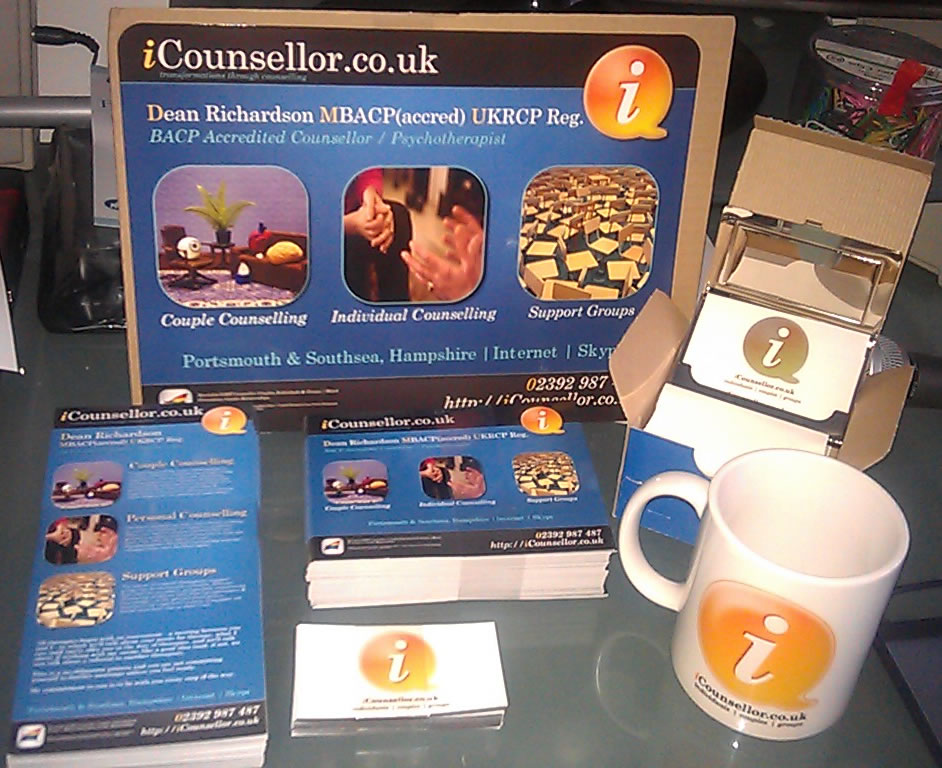
A description follows, and photographs are below.

Background.

I’ve been designing my own marketing material for some years, now, but whilst some of the paper one can obtain from Staples, PC World etc is of very good quality, some of the features of the media is lacking.

For example, glossy paper can only be printed on one side (print on the other side and the ink literally slides slowly off the paper as the print comes out of the ink jet printer!), heavyweight paper (280gsm) is reasonable for Rack Cards, but the equivalent in business cards feels a little flimsy and wrong.

The Project!

Use VistaPrint to upload my own designs, following their guidelines to the letter, take advantage of their many special offers, and see what things are like when I open the box upon arrival.

Conclusion.

I’m 90% happy.

Costs ended up as feeling reasonable – I was advised by a colleague to order the items but not pay for them – and wait for at least three offers of discounts by email.  In doing so I paid around £60 and saved around £150 – however, I’m not entirely convinced that these marketing items would have been worth £210 – suggesting to me that VistaPrint may artificially inflate their prices in order to give discounts.  Just my opinion.

Positive:

All the items “feel” right & (mostly) look right.

Colours look wonderful on most things and the “feel” of the items are what I’d expect when I pick them up (one gets a sense of something as being “cheap” or “quality” by their feel, and I get a “90%” feel of quality with all the items).


Negative:

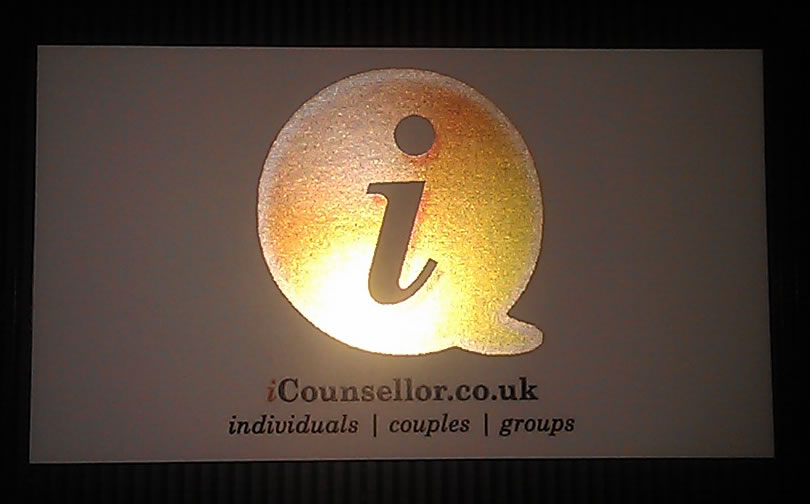
Foil: I choose to have “foil” business cards (which adds a layer of shiny metallic to areas of your card).  VistaPrint says: “When any colour ink is applied over the foil it creates a brilliant highlighting effect that seems to change colour. Your cards are distinctive and your designs really stand out.”  However, whilst the foil does make the card look “oooh shiny” it has also dulled the colour of my logo to the point of being drab.  I use highlights and gradients in my logo and the foil layer washes these subtleties away.

Packaging: VistaPrint wrapped most “multiple” item (eg 250 business cards) with a plastic band, and put every “banded” collection in an oblong box along with the mug wrapped in cardboard and the business cards in a separate box.  They added a couple of “air bags” to supposedly protect the items.  No way did this protect any of the items and the box bounced and rattled its way to my home.  Most of the items (eg postcards) have a slightly “damaged” feel to the edges – which may have been caused by the packaging, or may have been caused by a not-very-sharp cutting tool when it came off the printing press.


What would have made me 100% happy?

  • Sharply cut, neat edges on postcards and rack cards.
  • My business card’s “foiled” logo being as brilliantly coloured as on all the other items.
  • Professional packaging to protect all the items.

Photographs.

(Click the image to show larger version)

 All the items ordered from VistaPrint

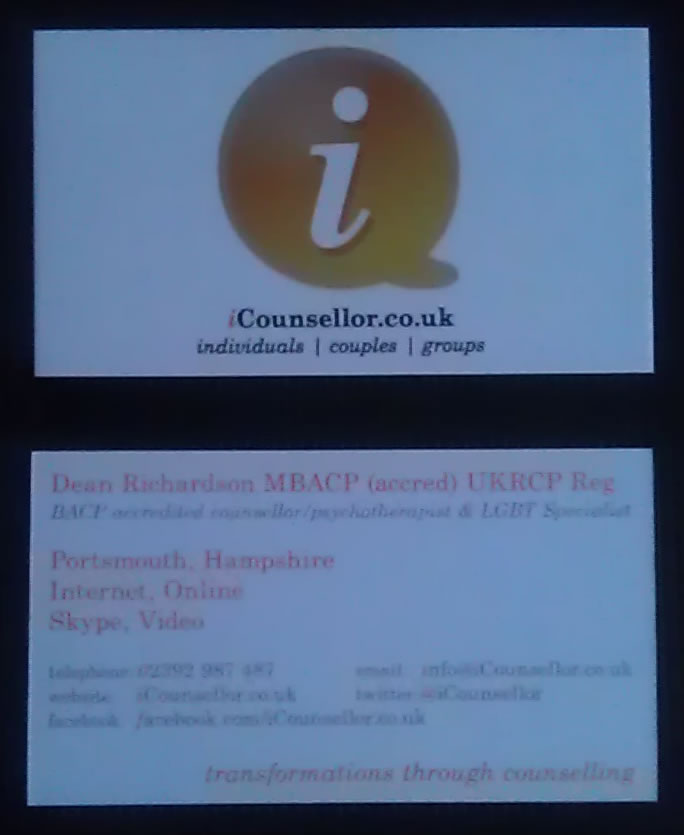
 Business Cards
Front: Colour, matt (silky feel), foil around logo.
Back: Colour, matt (rougher feel)

 Business Cards
Demonstrating the foil around the logo

 Business Card Holder
Metal holder – holds about 25 cards.

 Rack Cards
Front: Colour, glossy.
Back: Colour, matt.

 Postcards
Glossy front (grey scale on the back – not shown)

 Car Magnet
Small sized magnet to go on card door.

 Mug
I couldn’t resist just buying the one 😀

VistaPrint can be found at http://www.VistaPrint.co.uk/

Other sites of interest: Counselling via Skype, Online Zoom Counselling, Havant Counselling & Online Counselling for LGBTQ+ Partners.